
Golf cart insurance in Florida, and what “street legal” actually means
A homeowners policy covers a golf cart on your own property and stops at the kerb. Whether you need anything more depends on a line Florida draws by top speed, and a lot of owners are on the far side of it without knowing.
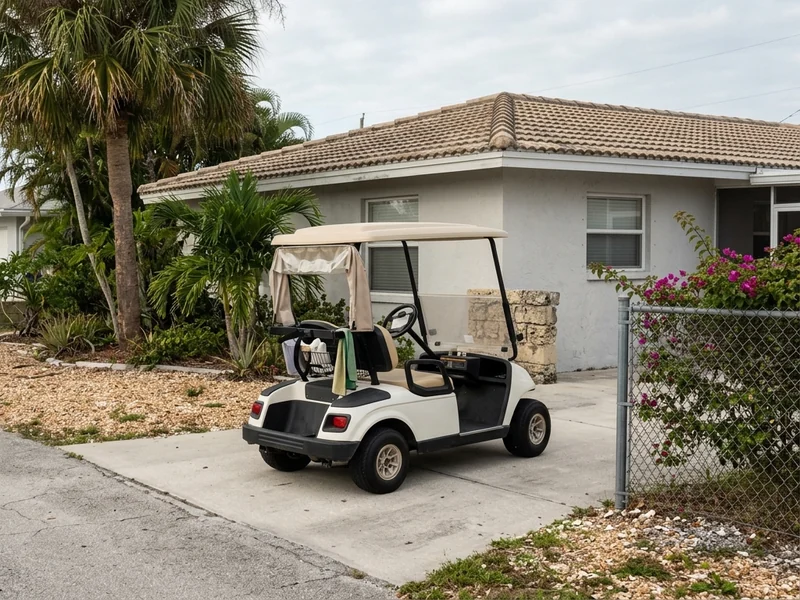
What this touches
- Liability for injury and damage you cause while driving it
- Physical damage: collision, theft and storm
- Medical payments for passengers, who are usually family
- Uninsured motorist, which matters because a cart loses every argument with a car
- Accessories, lift kits and custom wheels, which the base policy limits
A golf cart, a low-speed vehicle, and the line Florida draws between them
The line is top speed. Under F.S. 320.01(41) a low-speed vehicle is any four-wheeled vehicle whose top speed is greater than 20 miles per hour but not greater than 25. Cross that line and the state stops seeing a cart and starts seeing a motor vehicle: it has to be titled, registered and insured, and whoever drives it needs a valid driver license (F.S. 316.2122). Stay below it and a golf cart needs no title, no registration and no state-mandated insurance at all. Many carts sold as street legal are in fact low-speed vehicles, and their owners are driving an unregistered, uninsured motor vehicle without knowing it.
What moves the premium
- Whether it is a cart or a low-speed vehicle, which changes the coverage the state requires.
- Where it is driven: inside a gated community, or across public roads.
- Who drives it, including household members under 16, which several carriers exclude.
- Value and modifications, since a lifted cart with a lithium pack is not a base model.
Street legal is not a speed limit, it is a list of roads
F.S. 316.212 starts by prohibiting golf carts on public roads, then gives the exceptions. A cart may be driven only on a road a county, municipality or water control district has specifically designated for golf carts, after deciding carts can travel there safely and posting signs saying so. There is no statewide speed-limit rule that makes a road legal for a cart. The 35 mile per hour figure people quote belongs to low-speed vehicles under F.S. 316.2122(1)(a), not to carts.
What Florida requires of a golf cart
No title, no registration, and no state-mandated insurance. But there are rules. Under F.S. 316.212(7) a driver under 18 must hold a valid learner’s or driver license, and a driver 18 or over must carry valid government-issued photographic identification. Under (6) the cart needs efficient brakes, reliable steering, safe tires, a rearview mirror and red reflectors front and rear. Under (5) it is sunrise to sunset only, unless the local authority allows otherwise and the cart has headlights, brake lights, turn signals and a windshield.
What Florida requires of a low-speed vehicle
Everything a car needs, scaled down. Title under chapter 319, registration and insurance under F.S. 320.02, and a valid driver license in the operator’s possession. The equipment list in F.S. 316.2122(1)(b) is specific: headlamps, stop lamps, turn signal lamps, taillamps, reflex reflectors, parking brakes, rearview mirrors, windshields, seat belts and a vehicle identification number. Roads posted 35 miles per hour or less, though it may cross a faster road at an intersection.
The insurance a low-speed vehicle must carry
The same financial responsibility as any registered Florida vehicle: $10,000 of property damage liability under F.S. 324.022(1), and personal injury protection under F.S. 627.736. Two things about PIP are worth knowing before you rely on it. It pays 80 percent of reasonable medical expenses, not all of them, and it pays only if the injured person receives initial care within 14 days of the crash.
Your local rules can be stricter, never looser
F.S. 316.212(8) lets a local government pass an ordinance on golf cart operation and equipment that is more restrictive than the statute. So the honest answer to can I drive it here is always the county or city ordinance plus the signs actually posted on that road, and a community association can add requirements of its own on top.
The claim that surprises people
A passenger falls off. In a community with an active social calendar this happens more than any collision, the injuries are real, and medical payments plus liability on the cart is the only coverage that answers. Homeowners liability usually excludes motorised vehicles off the residence premises.
Questions people actually ask
Is a golf cart street legal in Florida?
Only on roads a local government has designated for golf carts and signposted as such, and only within the equipment, daylight and driver rules in F.S. 316.212. A cart that has been modified to do more than 20 miles per hour is no longer a cart in the eyes of the state: it is a low-speed vehicle, and it needs a title, registration, insurance and a licensed driver.
Do I need insurance for a golf cart in Florida?
The state does not require it for a golf cart. It does require it for a low-speed vehicle, under F.S. 320.02. Separately from the law, your community association may require liability coverage, and your homeowners policy almost certainly stops covering the cart once it leaves your property.
What is the difference between a golf cart and an LSV?
Top speed, and nothing else decides it. Greater than 20 and not greater than 25 miles per hour makes it a low-speed vehicle under F.S. 320.01(41). A dealer calling something street legal is not the test, and a cart upgraded with a faster motor or controller can cross the line after you bought it.
My community requires insurance. Is that the same thing?
The association usually requires liability only. That protects other people, not your cart and not the passenger who was riding with you.
Does my auto policy cover it?
Almost never. A cart is not a listed vehicle, and an LSV has to be added specifically.
Work it out before anybody sells you anything
Four calculators that run in your browser, a page for every situation Florida puts people in, and the claims data for your own county. All of it free, and none of it behind a form. The form is for the other half of the job: when you have read enough and want a person on the phone.
Leave a name and a number. This site is not an agency and employs nobody who can sell you a policy; it passes your request to a licensed Florida agent, who calls you. No obligation, and no call from six companies you have never heard of.
Your request goes to a licensed Florida agent, who may call, text or email you about it. That agent does not work for this site.